Work

Projects and portfolio

Case Studies & Evidence

Work, with the thinking left in

I’m drawn to work where the problem crosses boundaries: customer experience, product direction, technology, and the systems that help a team deliver. These selected stories show how I approach that work with others, what changed, and what I learned.

Showing 4 case studies for All Work.

Design system tokens diagram
Product & Experience

Enterprise Design System & Frontend Architecture

Unifying 14 fragmented web and desktop apps into a shared tokenized design system. Reduced UI implementation time by 40% with zero regression drift.
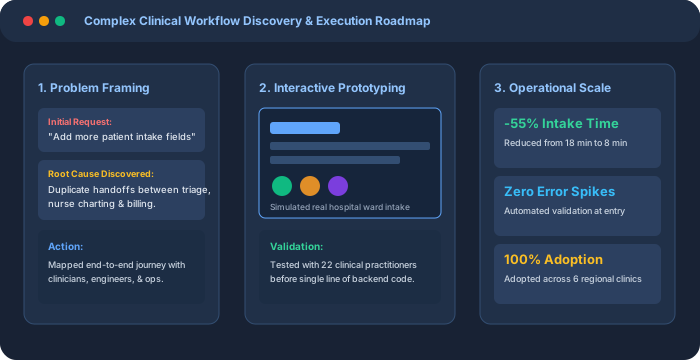
Clinical workflow discovery roadmap
Strategy & Transformation

Clinical Workflow Engine: Turning Ambiguity into Execution

Discovered root-cause bottlenecks across triage and physician charting through field shadowing. Cut intake latency from 18 min to 8 min (-55%).
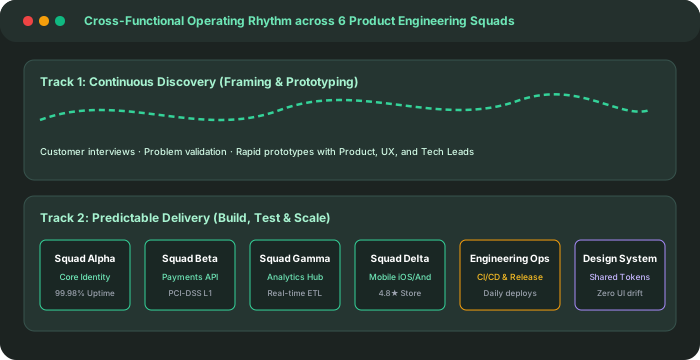
Squad operating model diagram
Team & Operating Systems

Scaling Engineering & Squad Operations Across 6 Squads

Scaled organization from 15 to 60+ engineers by instituting dual-track discovery and trunk-based delivery. Shifted from monthly batching to daily deploys.

Connected hardware mobile ecosystem diagram
Product & Experience

Connected IoT Hardware & Companion Mobile App Ecosystem

Re-engineered Bluetooth pairing state machine and local cache telemetry. Lifted first-time connection success from 78% to 98.4% and earned a 4.8★ store rating.

Note on confidentiality: Client and proprietary details have been responsibly generalized or anonymized to respect ongoing enterprise NDAs while accurately depicting the decision-making patterns and outcomes.

Enterprise Design System & Frontend Architecture

Unifying 14 disparate product suites into a single coherent interface architecture

Design system tokens diagram

The situation

The organization operated 14 separate web and desktop applications built over 8 years across multiple acquired business units. Each team had created isolated UI components, resulting in fragmented user experiences, accessibility non-compliance, and severe engineering duplication.

The question behind the question

The initial executive brief asked: “Can we build a common component library in React?” The deeper question was: How do we build governance, semantic tokens, and an engineering delivery pipeline so disparate squads actually adopt and maintain shared foundations without slowing roadmap commitments?

The approach

  1. Architected Multi-Tier Token Hierarchy: Separated Global Tokens (colors, spacing, typography) from Semantic Tokens (interactive surfaces, status indicators) and Component Tokens.
  2. Automated Sync from Figma to Code: Implemented Style Dictionary automation generating CSS variables, TypeScript types, and iOS/Android tokens.
  3. WCAG AAA Accessibility Standards: Tested all 48 core components with screen readers and keyboard navigation before release.
  4. Co-Creation Working Group: Formed bi-weekly guild office hours with frontend leads across all 14 squads.

What changed

What shipped: A fully documented, open-internal design system with 48 production-ready components and 300+ semantic tokens. Measured evidence: 40% reduction in front-end implementation time for new workflows; 0 visual regressions across quarterly platform releases.

What I learned

A design system is 20% craft and 80% organizational change management. Without clear contribution guidelines and mutual ownership with tech leads, shared libraries quickly rot.

Product & Experience